

Landing your first brand partnership is exciting—it means a brand values your content and wants to collaborate. However, excitement can turn to overwhelm as you address contract details: payment terms, usage rights, deliverables, timelines, and legal protections. Suddenly, the focus shifts from just creating content to managing vital business terms.
The good news? You’re not alone and you don’t need a law degree to navigate this. With the right checklist, negotiation strategies, and workflow, you can set the terms and sign with confidence, fulfill your part smoothly, and set the stage for long-term collaborations.
Platforms like Connext by Tech Bay Leafcan help simplify the process. As a US-based influencer marketing agency, Connext helps brands streamline everything from creator discovery and outreach to campaign management.
Let’s break it all down, step by step, so you can move smoothly from landing a deal to delivering results.
Why a Proper Contract Matters (ROI, protection, expectations)
Think of a brand partnership agreement as your safety net. It ensures you’ll actually get paid, clarifies what’s expected of you, and keeps both sides accountable.
Without a proper contract, you risk:
- Brands asking for more posts (sometimes for the same pay) than originally discussed.
- Delayed payments (sometimes months late).
- Losing control over how your content is used is like seeing your Instagram post in a Facebook ad without your consent.
On the other hand, a clear contract outlines ROI for the brand and protects you as the creator. Both sides know what success looks like, what needs to be delivered, and when the campaign officially ends.
Before You Sign: Prep Checklist for Creators & Brands
Before signing anything, slow down. Read carefully, and make sure the essentials are covered.
Must-have contract clauses (deliverables, timelines, payment, usage rights)
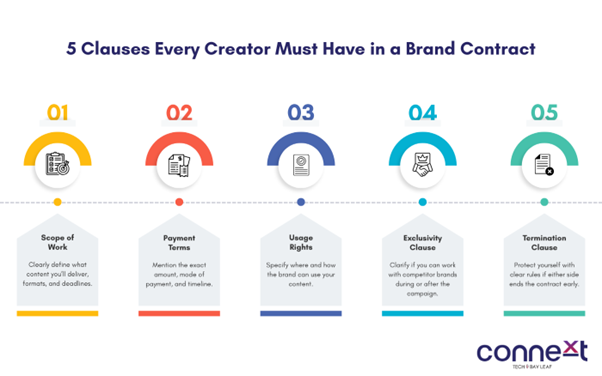
Your creator contract template should spell out:
- Deliverables timeline approval process — How many posts, videos, or stories are expected, and by when?
- Payment terms — What’s the fee, how is it split (upfront vs. after delivery), and how soon after posting will you get paid?
- Usage rights and licensing influencer content — Can the brand boost your post as an ad? Can they repurpose it for future campaigns?
- Revisions — How many rounds of edits are included before extra fees kick in?
- FTC disclosure influencer contracts — A reminder to use #ad or #sponsored to stay compliant.
Red flags to watch for in contracts
If you spot any of these, pause and ask questions:
- Vague influencer contract clauses for content usage like “all rights reserved in perpetuity.” Translation: Your work can be used forever without additional pay.
- “Net 90” payment terms (three months is way too long to wait).
- Missing details about what happens during payment disputes in influencer brand partnerships.
- Deliverables listed without clear approval steps.
Remember: what’s vague today can become a headache tomorrow.
Negotiation Tactics: How Creators Get Paid by Brands
Even if you’re new, you don’t have to accept every term as-is. Brands expect some back-and-forth, and professional negotiation actually builds respect.
Pricing models & performance clauses (flat fee, affiliate, rev share)
Not all creators get paid the same way. You might see:
- Flat fee — A straightforward “X amount for Y post.”
- Affiliate links — You earn commission per sale.
- Performance-based influencer payments — Extra pay if you hit KPIs like impressions or conversions.
- Revenue share — Riskier, but lucrative if you have a highly engaged audience.
Understanding these helps you negotiate influencer contract pay that aligns with your value. For example, if a brand insists on affiliate-only, you can counter with a base flat fee plus affiliate upside.
Mini Case Study: Affiliate-Only to Hybrid Model
A food blogger was offered an affiliate-only deal with a kitchenware company. She negotiated a base flat fee to cover her production costs plus the affiliate upside. The posts performed well, generating steady sales for the brand. Because both parties had a fair agreement, the blogger got guaranteed income and the brand got motivated performance. Lesson learned: don’t be afraid to counter with a hybrid model when affiliate-only feels risky.
Payment schedules, milestones and late-payment protection
To avoid cash flow stress:
- Ask for 50% upfront and 50% after final deliverables.
- Build in late-payment penalties (a small interest rate encourages faster payouts).
- Tie payment milestones to clear stages—like draft approval or campaign go-live.
A solid schedule ensures you’re not left chasing money weeks after doing the work.
Signing the Contract: Legal & Operational Steps
Once the terms look good, it’s time to make it official.
Using e-signatures and secure storage
Most brands use e-signatures in influencer agreements via tools like DocuSign or HelloSign. These are legally binding and much faster than mailing PDFs. After signing, keep copies in cloud storage (Google Drive, Dropbox) and label them clearly by campaign.
What to do if the brand requests changes
Brands sometimes return with tweaks. Don’t panic. Review carefully, and if you’re unsure, consider an influencer contract review service. You don’t need to hire a lawyer for every deal, but getting professional eyes on big contracts is worth it. Above all, never feel pressured to sign immediately—your future earnings depend on what’s in writing.
Fulfilling the Contract: Step-by-step Workflow
Congrats, you’ve signed! Now comes the fun part: creating and delivering.
Creative brief → First draft → Revisions → Final deliverables
The standard workflow looks like this:
- Creative brief — The brand gives you guidelines.
- First draft — You create the content (photo, video, post copy).
- Revisions — The brand requests edits, if needed.
- Final deliverables — You publish or hand over approved content.
Following this flow helps you fulfill influencer deliverables and approvals without last-minute chaos.
Mini Case Study: Creative Brief Saves the Day
A travel creator agreed to produce three reels for a tourism board. Because the creative brief clearly outlined tone, hashtags, and must-include landmarks, the first draft was approved with only minor tweaks. The campaign hit 1M views across platforms and led to a long-term ambassadorship. Lesson learned: a strong brief plus documented approvals means less back-and-forth and smoother delivery.
Want to see how Connext helps creators negotiate fairer deals? Book a free 15-min strategy call.
Tracking approvals and timestamps (tools & templates)
Approvals protect both sides. Tools like Trello, Asana, or even a Google Sheet with timestamps create a clear record. This way, if a dispute comes up, you can point to exactly when something was approved.
Measurement & Payment Reconciliation
After the content goes live, you’ll need to show results.
Reporting templates brands expect (KPIs, UTM, affiliate tracking)
Typical brand expectations include:
- Screenshots of reach, impressions, and engagement.
- Click-throughs tracked via UTM links.
- Affiliate sales or revenue reports.
Having a reporting template ready saves time and makes you look professional.
Resolving disputes & change requests
If a brand isn’t happy or delays payment, don’t panic. First, refer back to your brand partnership agreement. Provide proof of delivery (timestamps, screenshots, reports). If that doesn’t resolve things, escalate. Sometimes, even mentioning a formal complaint nudges payments along.
Post-Campaign: Repurposing assets & long-term partnerships
Once the campaign wraps, think beyond the short term.
Reuse rights, case study permission, testimonial requests
- If allowed, repurpose your campaign content for your portfolio.
- Ask brands if you can include the campaign in a case study or request a testimonial.
- Clarify whether they can reuse your content in ads (and negotiate extra pay if so).
Strong campaigns can lead to ongoing deals, so treat the wrap-up as the start of a potential long-term relationship.
Free Contract Checklist & Template
Feeling overwhelmed?. Use our creator contract template to cover the essentials. Download our free influencer contract template today and make your first brand deal stress-free. You’ll never have to wonder what to include in an influencer contract or how to sign a brand partnership contract again.
FAQs
Payment models vary.
Common options include:
Flat fee — a fixed amount per post, story, or campaign.
Affiliate links — commission for sales generated through your links.
Performance-based — bonuses for hitting KPIs like impressions, clicks, or conversions.
Revenue share — earning a percentage of overall campaign revenue.
You can also negotiate hybrids (e.g., a base fee + affiliate upside) to balance guaranteed income with performance incentives.
Key elements include:
Deliverables — what you’re creating (posts, stories, videos) and deadlines.
Payment terms — amount, split (upfront vs. after delivery), and schedule.
Usage rights — how the brand can use your content (ads, future campaigns, repurposing).
Revisions — how many rounds are included before extra fees apply.
FTC disclosure — #ad or #sponsored requirements to stay compliant.
Approval process — clear steps for brand review to avoid confusion.
First, check your contract for payment terms and any late-payment clauses. If payment is delayed, provide proof of delivery (screenshots, timestamps, reports) and follow up professionally. Many issues are resolved simply by referencing the contract. For persistent delays, escalate politely or use a formal notice — but always keep documentation.
Not always. For most standard deals, you can use a contract template and check clauses carefully. However, for high-value deals, complex licensing, or ambiguous terms, getting a lawyer or professional contract review service is worth it to protect your rights and earnings.
Yes, you can. Brands often want to repurpose your content for ads or future campaigns, and you don’t have to give that away for free. Always clarify duration and platforms, and charge extra for extended use.
